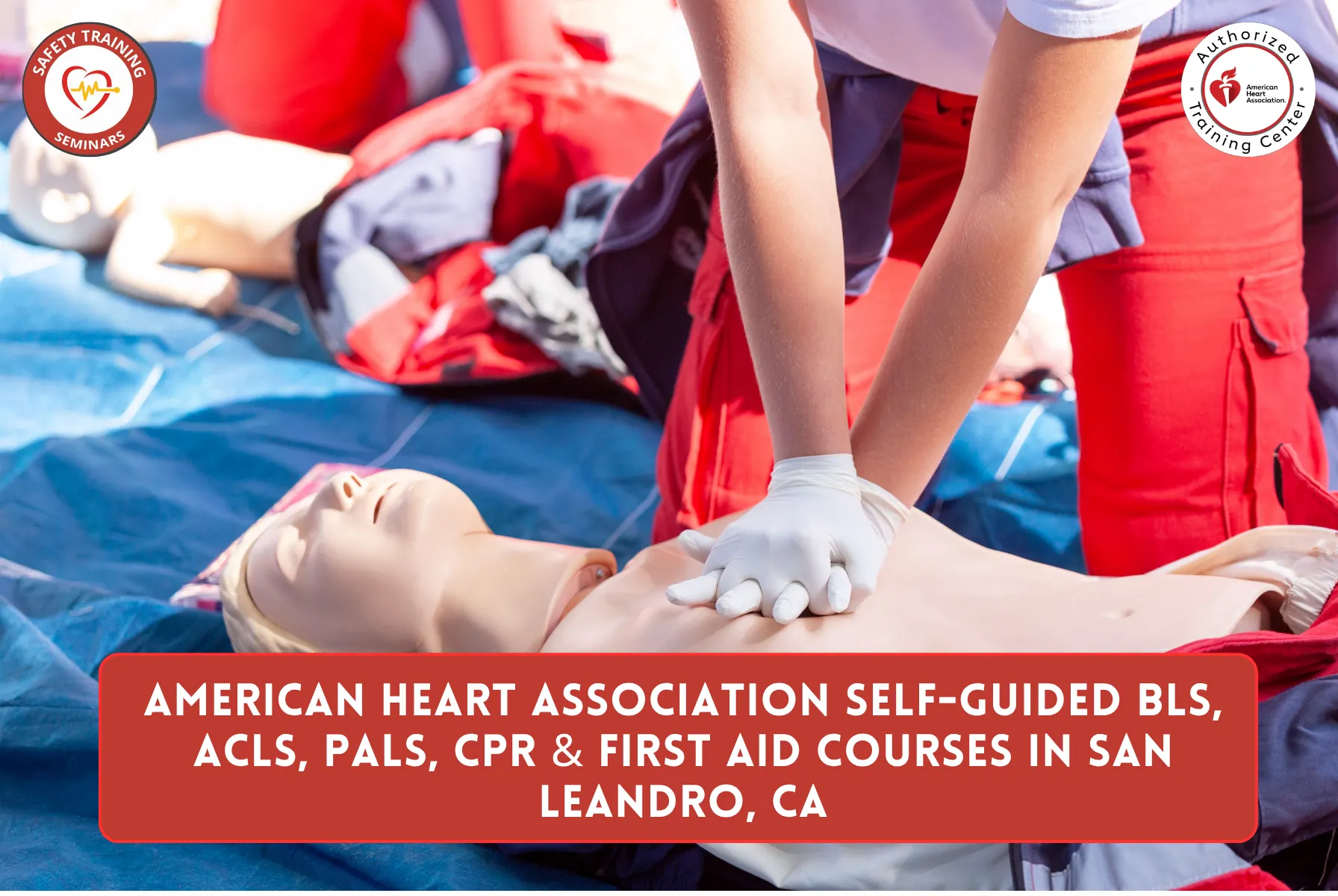
Finding the right American Heart Association® training format can be challenging when your work, school, or professional schedule does not fit neatly into a traditional classroom course. For learners in San Leandro, California, American Heart Association Self-Guided Learning can provide a more flexible way to complete the educational portion of applicable BLS, ACLS, PALS, CPR, AED, and First Aid training while addressing any required hands-on skills components.
This format can be especially useful for healthcare students, nurses, medical professionals, teachers, childcare workers, workplace employees, caregivers, and others who need specific training but have limited availability for fixed class times. The important point is to choose the course that matches your role and confirm the requirements of your employer, school, or organization before registering.
Key Takeaway
AHA Self-Guided Learning allows eligible learners to work through course material independently rather than relying entirely on a fixed classroom schedule. Depending on the course, educational learning may be combined with hands-on practice or skills verification, so it should not automatically be treated as an online-only course.
What Does AHA Self-Guided Learning Mean?
Self-Guided Learning is designed around independent study. Instead of completing every part of training during a conventional instructor-led classroom session, the learner works through the applicable educational material at their own pace.
The exact process depends on the course. A learner may first select the appropriate AHA course, complete its educational component, and then complete any required hands-on practice and skills testing. After successfully completing the applicable course requirements, the learner receives the appropriate course completion documentation or eCard.
That distinction matters. Self-guided does not necessarily mean that everything happens online without physical skills practice. Courses that require hands-on performance may still include a skills component. Before enrolling, check exactly what is included in the specific course you need.
For someone balancing clinical training, college classes, work shifts, or family responsibilities, this format can make the learning portion easier to fit into an existing schedule.
Which AHA Self-Guided Course Fits Your Role?
BLS in San Leandro
Basic Life Support (BLS) is generally intended for healthcare professionals and other individuals whose responsibilities call for healthcare-level basic life support training. Nurses, nursing students, physicians, EMTs, paramedics, medical assistants, dental professionals, and other healthcare personnel may encounter BLS requirements.
BLS differs from general public CPR because the training is structured around the needs of healthcare providers and appropriate professional settings. If your employer, nursing program, clinical placement, or healthcare organization specifically asks for BLS, verify that the course you select matches that requirement.
For healthcare students and working professionals around San Leandro, a self-guided format can be particularly useful when clinical schedules or coursework make a traditional class difficult to attend.
ACLS for Adult Cardiovascular Emergencies
Advanced Cardiovascular Life Support (ACLS) is intended for appropriate healthcare professionals involved in the management of adult cardiovascular emergencies. It goes beyond basic CPR concepts and addresses advanced emergency-care knowledge and skills relevant to qualified healthcare providers.
ACLS requirements are not identical for every healthcare role. Hospitals, employers, educational programs, and professional organizations may establish their own requirements. If you are a healthcare worker or student considering ACLS training, confirm the specific course and format required before you enroll.
PALS for Pediatric Emergency Care
Pediatric Advanced Life Support (PALS) focuses on emergency care involving infants and children and is intended for appropriate healthcare professionals whose roles involve pediatric emergency situations.
Healthcare professionals working with pediatric patients may need PALS depending on their position and workplace requirements. As with ACLS, the correct training should be determined by the expectations of your employer, school, clinical program, or organization rather than by the course title alone.
CPR, AED, and First Aid Training
CPR, AED, and First Aid training can be relevant to a much broader audience. Teachers, childcare providers, coaches, fitness professionals, workplace employees, caregivers, parents, and community members may seek this type of training.
Someone working in a school may have different training requirements from a nurse working in a clinical environment. Likewise, a childcare provider may need a different combination of CPR and First Aid training than an office employee.
The goal is not simply to find a CPR class. It is to identify the exact training your role requires and then select a format that satisfies that requirement.
How to Choose Between BLS, ACLS, PALS, CPR/AED, and First Aid
A simple way to narrow down your options is to start with your professional role:
| Course | Typical Audience |
| BLS | Healthcare professionals and appropriate healthcare students |
| ACLS | Healthcare professionals involved in adult cardiovascular emergency care |
| PALS | Healthcare professionals involved in pediatric emergency care |
| CPR/AED | General public and workplace audiences |
| First Aid | Workplace, education, childcare, community, and general audiences |
This table is a starting point rather than a universal rule. Your employer, school, licensing organization, healthcare organization, or training program may specify a particular course.
If you are unsure whether you need BLS or general CPR, ask the organization requesting your training before registering. Choosing a course based only on a search-engine result can lead to completing training that does not match the requirement.
Self-Guided Learning vs. Classroom and Online-Only Training
The biggest advantage of Self-Guided Learning is flexibility, but it is important to understand how the format differs from other options.
Self-Guided Learning: The educational material can be completed independently, allowing learners greater control over when they study. Where the course requires hands-on skills practice or testing, those components still need to be completed according to the applicable course process.
Traditional classroom training: Learners attend scheduled sessions and receive direct interaction with an instructor. This can be useful for people who prefer structured learning and set class times.
Online-only training: An online-only course may focus entirely on digital education. However, it may not meet a requirement when an employer, school, or organization expects hands-on skills practice or a particular AHA course format.
Therefore, the best option depends on what you are required to complete—not simply which format appears easiest.
Finding the Right Training Option in San Leandro
San Leandro serves a diverse group of professionals, students, families, and workers, so the reason for seeking CPR or healthcare training can vary considerably.
A nursing student may be trying to satisfy a clinical-program requirement while balancing coursework. A medical assistant may need to maintain training expected by an employer. A teacher or childcare worker may be looking for CPR and First Aid training appropriate for their workplace. Someone commuting between San Leandro and nearby East Bay communities may simply need a training option that works around an unpredictable schedule.
For local learners, the practical question is therefore twofold: Which course do I need, and which training format fits that requirement?
If you already know that BLS is the course you need, you can review the BLS and CPR classes in San Leandro to identify the appropriate local option. Learners considering several healthcare courses can also review the San Leandro CPR, BLS, ACLS, and PALS course information before making a decision.
Safety Training Seminars in San Leandro
Safety Training Seminars provides a local point of reference for people researching CPR and healthcare training options in San Leandro. The training center is located at 433 Callan Avenue, Suite 307, San Leandro, CA 94577.
Before registering, review the course information carefully and identify whether you need BLS, ACLS, PALS, CPR/AED, First Aid, or another specific training option. If your employer or school gave you a course name or requirement, use that information when comparing available options.
A local training option can also make the process easier to understand because you can focus your search on the course and format relevant to your particular situation rather than comparing unrelated online programs.
Why Consider Safety Training Seminars for CPR and BLS Training?
There are several practical reasons a learner may choose a local Safety Training Seminars option when researching CPR or BLS training:
- Local course information: San Leandro learners can review a training option associated with their local area rather than relying solely on distant providers.
- Multiple training needs: People researching BLS, CPR, ACLS, PALS, AED, or First Aid can determine which course best matches their situation.
- Flexible learning considerations: Learners with work, school, or personal scheduling constraints can investigate whether a self-guided format is appropriate for their selected course.
- Requirement-focused enrollment: Students can first identify what their employer, school, or organization requires before selecting a course.
- Clear next steps: Reviewing the relevant course and location information can help reduce confusion between general CPR training and healthcare-provider-focused courses.
The key is to choose based on the actual requirement rather than assuming that every CPR or life-support course serves the same purpose.
Practical Steps Before You Enroll
Before selecting an AHA Self-Guided Learning course, take a few minutes to confirm:
- Identify the required course. Find out whether you need BLS, ACLS, PALS, CPR/AED, First Aid, or another specific course.
- Ask who is requesting it. Your employer, school, clinical program, or organization should be able to clarify its requirement.
- Check the training format. Determine what portion is self-guided and whether hands-on practice or skills testing applies.
- Review course completion requirements. Make sure you understand what you must complete before receiving the applicable course documentation or eCard.
- Use a relevant local course page. Review the available San Leandro training information before registering.
Frequently Asked Questions
Is AHA Self-Guided Learning the same as an online-only CPR course?
No. Self-Guided Learning refers to an independent learning format, while an online-only course may provide education entirely through digital material. When a specific course includes hands-on practice or skills verification, those requirements still apply. Always check the format of the particular course and confirm that it satisfies your employer’s or school’s requirements.
Which course should a San Leandro healthcare student take?
The answer depends on the student’s program and clinical requirements. BLS is commonly relevant to healthcare students, while ACLS or PALS may apply to particular professional roles or clinical settings. Students should check with their nursing program, medical school, clinical placement, or other educational organization before enrolling.
Can I use Self-Guided Learning if my schedule changes frequently?
It may be useful for learners who have difficulty attending fixed classroom sessions because the educational component can be completed independently. However, flexibility does not remove any required hands-on or skills-testing component. Check the specific course process before assuming that every part can be completed on your own schedule.
How do I know whether I need BLS or CPR in San Leandro?
Start with the requirement given by your employer, school, or organization. BLS is generally designed for healthcare professionals and appropriate healthcare students, while CPR/AED training may be intended for general public and workplace audiences. If the requirement is unclear, ask the organization requesting the training before registering.
Where can San Leandro residents review local course options?
Learners can begin by reviewing the available Safety Training Seminars course and location information for San Leandro. Compare the course description with the requirement you have been given, particularly if you are deciding between BLS, CPR/AED, ACLS, PALS, or First Aid.
Conclusion
American Heart Association Self-Guided Learning can be a practical training format for San Leandro learners who need greater control over when they complete their educational material. However, self-guided training should not automatically be confused with online-only instruction, especially when a course includes hands-on skills practice or testing.
The right choice ultimately depends on your role and the requirement set by your employer, school, clinical program, or organization. Once you know which course you need, review the relevant Safety Training Seminars option and confirm the course format and completion requirements before registering. For local learners, starting with the appropriate San Leandro course page can make that decision much more straightforward.